

Property Management Blog

Who Is Responsible for Pest Control in an Alberta Rental? A Grande Prairie Landlord's Guide
Key Takeaways: Alberta's Minimum Housing and Health Standards require the owner to keep a rental free of insect and rodent infestations, so the landlord is responsible for pest control first. Tenants must keep the unit reasonably clean, allow entry and follow the exterminator's instructions, and can be charged only where evidence shows they caused or worsened the problem. Give 24-hour written notice before treatment, clean up mice safely, and report any suspected rat.
Once Grande Prairie nights drop below freezing, mice start looking for a warm way inside, and rental homes are no exception. For an owner, the first call about droppings in a kitchen drawer or scratching in a wall usually comes with a second question close behind: who is responsible for dealing with it, the landlord or the tenant?
In Alberta the answer is clearer than many owners expect. This guide explains who is responsible for pest control in an Alberta rental, when a tenant can be asked to pay, how to enter the unit to treat a problem, what happens if an infestation is ignored, and how to prevent the common fall and winter pests before they become a dispute. It is general information, not legal advice, and every rule below comes from a public source listed at the end of the article.
The short answer: the landlord is responsible first
Section 16(c) of Alberta's Residential Tenancies Act (RTA) makes it a covenant of every residential tenancy agreement that the premises will meet at least the minimum housing standards made under the Public Health Act. Section 4 of the Housing Regulation then requires every owner to maintain the housing premises in compliance with the Minimum Housing and Health Standards.
Those standards are direct on pests. Section 16(a) states that the owner shall ensure that the housing premises are free of insect and rodent infestations. The Centre for Public Legal Education Alberta (CPLEA) sums it up the same way: the landlord must make sure the rental property is free of insect and rodent infestations, and must make sure the premises comply with public health requirements at all times.
Because this obligation comes from a public health standard, a lease clause that says "tenant is responsible for all pest control" does not move the legal duty off the owner. The tenant still has real obligations, covered below, but the starting point is that the owner deals with an infestation.
What a tenant is responsible for
Tenants are not off the hook. Under RTA section 21, every tenancy agreement includes tenant covenants to maintain the premises in a reasonably clean condition (21(f)) and not to do or permit significant damage to the premises (21(e)). The Minimum Housing and Health Standards add two pest-specific duties: section 16(a)(iii) makes it the occupant's responsibility to allow access and do whatever is necessary to get the unit ready for a pesticide application, and section 17 says every tenant shall allow access for repairs or pest control treatment as the RTA requires.
In practical terms, CPLEA lists three things a tenant must do: keep the property reasonably clean, allow entry for pest control treatment, and follow the instructions of the exterminator. That last point matters most with bed bugs and cockroaches, where treatment usually fails if the tenant does not bag laundry, clear floors or leave the unit for the required time.
A real Alberta case: who paid for a long-term mouse infestation
The clearest local example is Hometime Property Services Ltd v Girumnesh, 2022 ABPC 172, summarized by Stillman LLP in 2023. A landlord sued a former tenant for just over $8,000 to exterminate and remediate a mouse infestation that a pest contractor described as long term. The new tenant had found the mice while moving in.
The court dismissed the claim. It held that responsibility for exterminating and remediating a mouse infestation sits on the landlord at first instance, under RTA section 16(c) and section 16(a) of the Minimum Housing and Health Standards. A landlord could have recourse under section 21(e) if a tenant caused an infestation, allowed someone else to create one, or wilfully failed to report one, but none of that was proven. Notably, the infestation had not been caught at three check-in inspections during the tenancy, at the move-out inspection, or at the new tenant's move-in inspection.
The lesson for owners is less about mice than about evidence. If you cannot show what the unit looked like before and during a tenancy, a court or tribunal starts from the presumption that the cost is yours.
When can a landlord charge the tenant for pest control?
Sometimes, but the owner carries the burden of proof. CPLEA explains that if a landlord believes the tenant should pay, the landlord can bill the tenant or deduct the treatment cost from the security deposit. If the tenant disputes it, the landlord will have to bring evidence, for example that the tenant did not follow the exterminator's instructions, and a judge or tenancy dispute officer decides based on that evidence.
The kinds of evidence that tend to matter are a detailed move-in inspection report with photos, written pest reports dated when the problem was raised, the pest control operator's findings on likely cause, the preparation sheet given to the tenant, and records showing whether the tenant followed it. Our guide to Alberta security deposit rules covers the inspection report and 10-day refund requirements that apply to any deduction, and our RTDRS guide for landlords explains how these disputes are heard.
Entering the rental to treat pests
Alberta's RTA names pest control specifically as a reason a landlord can enter without the tenant's consent. Section 23(3)(c) allows entry, after notice, to take necessary steps to control pests so the premises meet the standards required under Alberta law.
The notice rules in section 23(4) and (5) still apply. Written notice must be served at least 24 hours before entry, signed by the landlord or agent, state the reason for entry, and give a date and time of entry. Entry must be between 8 a.m. and 8 p.m. and not on a holiday, with special rules if the tenant has given written notice of a different day of religious worship. Pest work often takes more than one visit, so build each follow-up treatment into its own notice rather than relying on the first one.
When a pesticide is applied inside a dwelling, section 16(a)(ii) of the Minimum Housing and Health Standards also requires the occupant to be notified in line with Alberta's Environmental Code of Practice for Pesticides, and section 16(a)(i) requires pesticides to be applied in accordance with the Environmental Protection and Enhancement Act. That is one reason most owners use a licensed pest control operator rather than spraying a tenant's home themselves.
What happens if an infestation is not fixed
A tenant who reports pests in writing and gets no response can contact Environmental Public Health through Alberta Health Services or call Health Link at 811. CPLEA notes that a health inspector can investigate and order the landlord to deal with the problem. AHS publishes these orders online, and recent ones show how routine they are: inspectors have cited section 16(a) for cockroaches in an Edmonton unit in April 2025 and for bed bugs in a Coalhurst home in August 2026.
If the landlord does not comply with a public health order, RTA section 28 lets the tenant apply to end the tenancy or serve a 14-day notice to terminate for substantial breach. The landlord can only stop that notice by objecting in writing within 7 days and showing the order has been complied with or stayed. Section 25 also prohibits terminating a tenancy or taking any retaliatory action, including a financial penalty, against a tenant because they made a complaint under the RTA or the Public Health Act.
Put simply, a slow response to a mouse or bed bug report can turn into a health order, a lost tenancy and a vacancy. Our rental safety standards guide covers the other minimum standards an inspector will look at while they are in the unit.
Mice and hantavirus: clean up safely
Mice are the pest Grande Prairie owners are most likely to deal with this season, and they bring a health risk of their own. The Government of Alberta reports 81 confirmed hantavirus cases and 15 deaths in Alberta since reporting began in 1989, including one death in 2026. Hantavirus pulmonary syndrome spreads when people inhale particles from the urine, droppings or saliva of infected rodents, usually deer mice, and the risk rises when contaminated areas are disturbed.
Alberta's guidance is specific. Ventilate the area for at least 30 minutes before starting, wear rubber gloves, soak droppings, nests and dead mice with a solution of one part bleach to nine parts water or a household disinfectant, and let it sit five minutes before wiping up with paper towels and sealing everything in a bag. Never vacuum or sweep droppings. For significant infestations or poorly ventilated spaces such as crawlspaces, call Health Link 811 for advice.
This matters most for vacant units, garages, sheds and crawlspaces that sit closed for weeks. Give these instructions to any cleaner or contractor working in an empty rental, and add them to your Alberta landlord turnover checklist.
Bed bugs and cockroaches in multi-unit buildings
Bed bugs and cockroaches move between units, which is why the standards also make the owner responsible for keeping common rooms and areas clean and sanitary. Alberta Health Services has advised that landlords and property managers must hire a licensed pest control operator to address confirmed bed bug infestations, and Service Alberta's consumer tips for landlords use "no bed bugs" as an example of what a habitable rental means at the start of and throughout a tenancy.
In a duplex, fourplex or house with a suite, treating one unit and ignoring its neighbour often means paying twice. Ask your pest control operator whether adjoining units should be inspected at the same time, and give each tenant a separate written entry notice. If you own a condo, check whether the corporation or the unit owner handles pest treatment in common property; our guide to renting out a condo in Grande Prairie covers how bylaws and the Condominium Property Act interact with the RTA.
Alberta is rat-free, and owners help keep it that way
Alberta has had a Rat Control Program since 1950. Under the Agricultural Pests Act and the Pest and Nuisance Control Regulation, the Norway rat and any other rat of the genus Rattus are declared pests, and every person and municipality must take active measures to prevent rats from establishing on their property. Keeping pet rats is illegal in Alberta.
Rat-free does not mean rats never appear. The province confirmed 23 rats in 2023 against 435 reports that turned out to be other animals, such as muskrats, gophers and mice. If you or a tenant see what looks like a rat, safely take a photo, note the location, and report it by emailing rats@gov.ab.ca, calling 310-FARM (3276), or contacting your local agricultural fieldman. Do not try to treat a suspected rat problem quietly.
A fall pest-prevention plan for Grande Prairie rentals
Prevention is cheaper than treatment and much easier to defend in a dispute. Before winter, walk the exterior and seal gaps around pipes, utility lines, dryer vents and garage door seals, trim vegetation back from the foundation, and move firewood and debris away from the house. Confirm garbage and recycling bins have tight lids and that tenants know the collection schedule. Our winterizing guide pairs well with this exterior check.
Inside the lease, add a pest addendum that asks tenants to report signs of pests in writing within a set time, explains that the landlord will arrange treatment, sets out the tenant's duty to prepare the unit and follow the operator's instructions, and states that costs may be claimed where the tenant caused the problem. A clause like that does not override the owner's legal duty, but it documents the tenant's obligations and the reporting expectation that the Hometime court found missing.
Finally, look for pests on purpose at every inspection. Note droppings, gnaw marks, staining on mattresses and seams, and any gaps in the building envelope, and photograph them. Our guide on how to conduct a tenant walkthrough inspection covers how to document conditions so the record holds up later.
A quick checklist when a tenant reports pests
Acknowledge the report in writing the same day. Book a licensed pest control operator and ask for a written report on the pest, the extent of the problem and likely cause. Serve a proper 24-hour written entry notice for each visit. Give the tenant the operator's preparation sheet and the pesticide notification the standards require. Check adjoining units in shared buildings. Keep invoices, photos and follow-up results together, and only pursue the tenant for costs where the evidence shows they caused or worsened the problem.
Let Sutton handle the pest calls
Pest reports rarely arrive at a convenient time, and the response window is where most owners lose either money or a good tenant. Sutton Property Management manages rental properties across Grande Prairie, from marketing and tenant screening to rent collection and day-to-day tenant communication. Learn more about our Grande Prairie property management services, or contact our office to talk about your rental before winter sets in.
Sources: Residential Tenancies Act, SA 2004, c R-17.1, ss. 16, 21, 23, 25 and 28; Housing Regulation, Alta Reg 173/1999, s. 4; Government of Alberta, Minimum Housing and Health Standards (rev. June 30, 2012), ss. 16 and 17; Centre for Public Legal Education Alberta, "FAQ – Who is responsible to treat bugs in a rental property?" (November 2023); Stillman LLP, "A Mouse in My House: Understanding Minimum Housing and Health Standards for Residential Tenancies" (March 2023), discussing Hometime Property Services Ltd v Girumnesh, 2022 ABPC 172; Alberta Health Services, public health orders (Edmonton, April 29, 2025; Coalhurst, August 26, 2026) and "Don't let the bedbugs bite this holiday season" (2011); Service Alberta, "Consumer Tips – Information for Landlords" (May 2024); Government of Alberta, "Reducing the risk of hantavirus"; Government of Alberta, "Alberta's Rat Control Program" and "Rat prevention and control". This article is general information, not legal advice. Confirm your obligations for a specific property with Alberta Health Services, a licensed pest control operator, or a lawyer.

Smoke and Carbon Monoxide Alarm Rules for Alberta Rentals: A Grande Prairie Landlord's Guide
Key Takeaways: Every Alberta rental must have smoke alarms that are operational and in good repair at all times, and the fire code requires owners of leased homes to test and clean them before each tenancy and give tenants maintenance information. CO alarms are required in newer homes with fuel-burning appliances or attached garages and are strongly recommended everywhere else. Replace alarms older than 10 years and put an alarm addendum in every lease.
Fire Prevention Week runs October 4 to 10 this year, and it lands just as Grande Prairie furnaces, fireplaces and space-heating habits switch back on for winter. For a rental owner, that timing is a useful reminder: smoke alarms and carbon monoxide (CO) alarms are not just good practice in Alberta. They are part of the legal standard your rental has to meet, and the code places specific duties on the owner of a leased home.
This guide explains what Alberta law requires for smoke and carbon monoxide alarms in a rental, who is responsible for testing them, what changes when a property has a secondary suite, and how to build alarm checks into your leases and turnovers. It is general information, not legal advice, and every rule below comes from a public source listed at the end of the article.
The short answer: every Alberta rental needs working smoke alarms
Alberta Health's MyHealth.Alberta.ca puts it plainly: under Alberta law, all dwelling units, including rental units, must have smoke alarms. Three layers of rules work together to make that happen.
First, Alberta's Residential Tenancies Act (RTA) makes it a covenant of every residential tenancy agreement, in section 16(c), that the premises meet at least the minimum housing standards made under the Public Health Act. Second, those Minimum Housing and Health Standards (M.O. 57/2012) include a dedicated smoke alarm section. Third, the National Fire Code – 2023 Alberta Edition, enforced under the Safety Codes Act, sets out how smoke alarms must be installed, tested and maintained, with a specific rule for owners of leased dwelling units.
A lease clause cannot contract out of any of these. Even if a tenant agrees to "look after the smoke detectors," the minimum standard stays with the property.
What the Minimum Housing and Health Standards require
Section 12 of the Minimum Housing and Health Standards says smoke alarms within dwellings must be installed between each sleeping area and the remainder of the suite, and where hallways serve the sleeping areas, the alarms must be installed within the hallway. It also says smoke alarms must be operational and in good repair at all times.
"At all times" matters. A missing alarm, a unit with the battery pulled, or a device hanging off the ceiling after a paint job is a housing standards problem, and a tenant can raise it with Alberta Health Services the same way they would raise a heating or plumbing issue. Our guide to rental safety standards covers the other systems an inspection should look at alongside alarms.
What the Alberta Fire Code adds for leased homes
The National Fire Code – 2023 Alberta Edition contains a rule written specifically for landlords. As summarized by the Calgary Fire Department in its 2024 owner's guide, Division B, Sentence 6.7.1.1.(4) says the owner of a leased dwelling unit must ensure smoke alarms within the unit are tested and cleaned before occupancy, and must give tenants information about ongoing smoke alarm testing and maintenance.
The same code requires smoke alarms to be inspected, tested and maintained in conformance with CAN/ULC-S552, the national standard for smoke alarm maintenance, and requires carbon monoxide alarms to be inspected, tested and maintained according to the manufacturer's instructions. Fire protection installations in general must be kept in operating condition.
The Safety Codes Act defines "owner" broadly, including a lessee, a person in charge, and a person who has care and control of the property, and the code makes the owner or the owner's authorized agent responsible for carrying out its provisions. The Grande Prairie Fire Department's building owner guide notes that under section 68(1) of the Act, owners who fail to comply with fire code maintenance requirements can face fines of up to $100,000 and up to six months in jail for a first offence, and up to $500,000 and 12 months for subsequent offences. Those are maximums, not typical penalties, but they show how seriously the province treats life safety equipment.
Where smoke alarms need to go
Installation requirements come from the building code that applied when the home was built or renovated, so an older Grande Prairie bungalow and a 2024 infill will not look the same. For homes built under the current National Building Code – 2023 Alberta Edition, the Calgary Fire Department summarizes the requirement as smoke alarms on each storey including basements, in each sleeping room, and in the hallway between sleeping rooms, on or near the ceiling. Where more than one alarm is required, they must be interconnected so that one alarm sounding sets off all of them.
The fire code allows smoke alarms to be battery-operated in dwelling units built before July 5, 1977. Newer homes are generally expected to have alarms connected to the electrical system, and Alberta's electrical STANDATA bulletin on smoke and CO alarms (April 2025) explains how hardwired and interconnected alarms are to be wired.
If you are not sure what your property's original permit required, assume the higher standard when replacing alarms. Never swap a hardwired, interconnected alarm for a stand-alone battery unit just because it is easier. When in doubt, Grande Prairie Fire Prevention can be reached at 780-538-0400.
Carbon monoxide alarms: when they are required
Carbon monoxide is invisible, odourless and tasteless, and Alberta's Safety Codes Council notes that heating and cooking equipment, vehicles idling in an attached garage, and back-drafting chimneys can all bring it into a home.
The Alberta Building Code requires certified CO alarms in every new building that contains a residential occupancy and also contains a fuel-burning appliance, an attached storage garage, or both. Where a fuel-burning appliance is in a suite, a CO alarm must be installed inside each bedroom or, if outside the bedroom, within 5 metres of each bedroom door, measured along corridors and doorways. Rooms with a solid-fuel-burning appliance such as a wood stove need their own mechanically fixed CO alarm. Suites that share a wall or floor/ceiling assembly with a service room containing a fuel-burning appliance, or with an attached garage, have similar requirements.
For existing homes built before these rules applied, the province's safety guidance says CO alarms are highly recommended rather than mandated retroactively. For a rental, that distinction is thin comfort. Most Grande Prairie homes heat with natural gas, many have attached garages, and Grande Prairie Fire Marshal Chris Renyk told My Grande Prairie Now in November 2025 that he recommends switching basement alarms to combination smoke and CO units. A CO alarm costs little compared to the consequences of not having one, and Alberta's guidance confirms that combination units meeting both the smoke alarm and CO alarm standards are acceptable.
Secondary suites need their own, connected alarms
If your property has a basement or backyard suite, alarm requirements get stricter. Alberta's carbon monoxide safety guidance states that homes containing a secondary suite must have CO alarms in both the main dwelling and the secondary suite, and that these must be hardwired and interconnected so they operate in unison. Alberta's secondary suite building standard (STANDATA 23-BCB-007R1) also calls for interconnected smoke alarms. Our secondary suite guide for Grande Prairie owners covers the permit and building requirements that come with legalizing a suite.
Interconnection also creates a practical issue: a nuisance alarm in one unit wakes the other household. That makes it even more important that both tenants know how to test and silence their alarms correctly, and that neither household disables a device to stop false alarms.
Testing, batteries and replacement
The fire code ties testing to CAN/ULC-S552 and the manufacturer's instructions, and the Grande Prairie Fire Department's public advice is straightforward. In the same November 2025 interview, Fire Marshal Renyk recommended testing smoke alarms monthly, changing batteries once a year, and replacing any alarm older than 10 years because the sensor degrades over time even when the unit seems fine.
For a rental, divide the work this way. The owner tests and cleans every alarm before each new tenancy, replaces units that are past the manufacturer's replacement date or that fail a test, and keeps a record. The tenant tests monthly, replaces accessible batteries when needed if the lease says so, and reports any problem right away. Many current alarms have sealed 10-year batteries, which reduces the chance of a tenant borrowing a battery for the TV remote.
Check the date printed on the back of each alarm during every inspection. An alarm with no visible date should be treated as past its life.
Building alarm checks into your turnover and inspections
The pre-occupancy test the fire code requires fits naturally into a move-in routine. Add a line to your move-in inspection report for each alarm, recording its location, its manufacture date, and that it was tested and cleaned, and have the tenant initial it. Our Alberta landlord turnover checklist shows where this sits among the other steps between tenants.
During the tenancy, routine inspections are a good time to confirm alarms are still in place and working. Under section 23 of the RTA, a landlord can enter for inspection or repairs with at least 24 hours' written notice that states the reason, date and time, and entry must be between 8 a.m. and 8 p.m. and not on a holiday or the tenant's day of religious observance. If a tenant reports a beeping or failed alarm, treat it as urgent: a dead smoke alarm in January is not a repair to schedule for next month. Our emergency maintenance guide explains how to triage these calls.
What to put in the lease
Because the fire code requires owners to give tenants information about ongoing alarm testing and maintenance, a short written alarm addendum is the cleanest way to meet that duty and prove it. It should list the location and type of each alarm, tell the tenant how and how often to test it, explain what to do when an alarm chirps or sounds, and state who replaces batteries.
Add a clause that the tenant must not remove, disconnect, cover or disable any smoke or CO alarm and must report damaged, missing or malfunctioning alarms promptly. If the property has a fuel-burning fireplace or wood stove, include basic use rules. Our article on key terms in an Alberta lease agreement covers how addenda fit into the rest of the agreement.
Why it matters for insurance and liability
Working alarms protect tenants first, but they also protect the owner. A fire or CO incident in a unit where alarms were missing, expired or never tested before move-in raises hard questions under the housing standards, the fire code and the Safety Codes Act, and a written test record is the simplest evidence that you met your duties. Review your policy wording as well; our guide to landlord insurance in Alberta explains the conditions owners most often overlook.
A Fire Prevention Week checklist for Grande Prairie rental owners
This week, confirm every rental has a smoke alarm in each location its building standard requires, check manufacture dates and replace anything older than 10 years, add CO alarms wherever there is a fuel-burning appliance or attached garage even if the home predates the requirement, confirm that secondary suite alarms are hardwired and interconnected, put an alarm addendum into every lease, and record alarm tests on every move-in inspection. This year's Fire Prevention Week theme is lithium-ion battery charging safety, so it is also a good moment to remind tenants not to charge e-bikes or scooters in hallways or near exits.
Let Sutton handle the safety details
Alarm testing, records and urgent repair calls are easy to let slide when you manage rentals around a full-time job. Sutton Property Management manages rental properties across Grande Prairie, from marketing and tenant screening to rent collection and day-to-day tenant communication. Learn more about our Grande Prairie property management services, or contact our office to talk about your rental before winter.
Sources: Residential Tenancies Act, SA 2004, c R-17.1, ss. 16 and 23; Government of Alberta, Minimum Housing and Health Standards (M.O. 57/2012), s. 12; National Fire Code – 2023 Alberta Edition, Div. B 2.1.3.3, 6.1.1.2 and 6.7.1.1, and Div. C 2.2.1.1, as summarized in Calgary Fire Department, "Short Term Rentals, Owner's Responsibility Guide" (May 2024); Grande Prairie Fire Department, "Building Owner's Fire Safety Maintenance Requirements"; Safety Codes Council / Alberta Municipal Affairs, "Carbon Monoxide Alarm Home Installation" safety tip (January 2020); Alberta Municipal Affairs, STANDATA 24-ECB-032 (April 2025) and 23-BCB-007R1; MyHealth.Alberta.ca, "Smoke Alarms and Home Safety"; My Grande Prairie Now, "Fire Marshal reminding the community to check CO, smoke alarms" (November 14, 2025); NFPA and Canada Gazette, Fire Prevention Week 2026 (October 4–10). This article is general information, not legal advice. Codes and standards change, so confirm current requirements for your property with the Grande Prairie Fire Department, a qualified electrician, or a lawyer.
Who Pays Utilities in a Grande Prairie Rental? Alberta Heat and Utility Rules for Landlords
Key Takeaways: Alberta's RTA leaves utility payment to the lease, but every Grande Prairie rental must have heat capable of keeping habitable rooms at 22°C, and owners must keep electricity, water and heat flowing unless the lease makes the tenant solely responsible. Winter disconnection rules don't cover water or vacancies, so name every utility in the lease and keep the heat on between tenants.
Every fall, the same question surfaces in Grande Prairie rentals: who is paying for the heat this winter, and what happens if it stops? Utility arrangements that seemed obvious in July can turn into a frozen-pipe claim, a public health complaint, or an unpaid water bill in January if nobody wrote them down properly.
This guide explains who pays utilities in an Alberta rental, the heating standard every landlord must meet, how winter disconnection rules work, how water accounts are handled through Aquatera, and what to put in your lease before the cold arrives. It is general information, not legal advice, and every rule below comes from a public source listed at the end of the article.
The short answer: the lease decides who pays, but the owner is responsible for heat
Alberta's Residential Tenancies Act (RTA) does not say whether the landlord or the tenant pays for electricity, natural gas, or water. That is a matter for the residential tenancy agreement. Alberta's Utilities Consumer Advocate (UCA) describes three common set-ups: the tenant pays every utility directly to the retailer, the tenant pays some or all of the utility cost to the landlord, who keeps the accounts in their name, or the landlord pays everything and builds it into the rent.
What the lease cannot do is contract out of the province's minimum housing standards. Section 16(c) of the RTA makes it a covenant of every residential tenancy agreement that the premises will meet at least the minimum standards prescribed for housing under the Public Health Act and its regulations. Those standards say a lot about heat.
Alberta's minimum heat standard: 22°C
Alberta's Housing Regulation (AR 173/1999) requires an owner to supply heating facilities capable of maintaining a habitable indoor temperature if the premises are used at any point between September 1 and May 1, which in Grande Prairie means every rental. The regulation also requires owners to maintain their premises in line with the province's Minimum Housing and Health Standards.
Section 8 of those standards sets the numbers. Heating facilities must be properly installed, kept in good working condition, and able to heat all habitable rooms, bathrooms, and toilet rooms to at least 22°C (71°F). Where someone other than the occupant controls the heat, such as a building with a central boiler or a basement suite on the upstairs thermostat, the space must actually be maintained at 22°C or more. When the outside temperature drops below the Alberta Building Code's winter design temperature, a public health executive officer may permit an indoor temperature lower than 22°C but above 16°C. Cooking appliances and portable space heaters cannot be the primary source of heat for a habitable room.
In practice, that means a furnace that cannot keep the back bedroom warm in February is the owner's problem, regardless of who pays the gas bill. Fall furnace servicing and filter changes belong on the same checklist as the other items in our guide to preparing a rental property for winter.
The continuous-supply rule, and the one exception
The Minimum Housing and Health Standards add a second obligation that matters even more for utility arrangements. Section 8(d) states that every owner must ensure a continuous supply of electricity, water, and heat unless the rental agreement stipulates that those utility services are the sole responsibility of the occupant.
That sentence is the reason the utility clause in your lease matters. If the lease clearly makes the tenant responsible for a utility, the continuous-supply duty for that service shifts to them. If the lease is vague, says "utilities included," or splits costs informally, the owner should assume the duty to keep the service running sits with them.
If a tenant reports that the heat or water is not working and the problem is not fixed, Alberta's MyHealth guidance tells renters they can contact Environmental Public Health. A public health inspector may inspect the unit and speak with the landlord. Under section 28 of the RTA, if an executive officer issues an order under the Public Health Act about a substantial breach and the landlord does not comply, the tenant can end the tenancy on 14 days' written notice.
Option 1: Tenant holds the accounts
For single-family homes and units with their own meters, the cleanest arrangement is usually for the tenant to open electricity and natural gas accounts in their own name before move-in. The UCA recommends that tenants set up service at least three days before they take possession.
The UCA is clear on the main advantage: if the accounts are in the tenant's name and they fall behind, the landlord is not responsible for those charges, because the retailer has to collect from the account holder. The disadvantage is visibility. The utility company can disconnect for non-payment, and privacy rules mean it is not required to warn the property owner. The disconnection notice goes to the tenant. If you later need service restored, you may be the one paying the reconnection fee.
That is why a good lease pairs "tenant pays" with obligations to keep the service active for the entire tenancy, keep the unit heated, and provide proof that accounts are open at move-in.
Option 2: Landlord holds the accounts and recovers the cost
Many basement suites, side-by-sides, and older multi-unit buildings share a single meter, so one person has to hold the account. If you keep the accounts and charge the tenant a share, the UCA notes that a fixed amount written into the lease cannot be changed unless both parties agree. If you charge a variable share, spell out the formula, the billing date, and how the tenant can see the underlying bill.
The owner carries the credit risk in this set-up. If the tenant stops paying their share, the UCA points landlords to the Residential Tenancy Dispute Resolution Service. Our guide to RTDRS for Alberta landlords explains how that process works for unpaid amounts.
For a house with a secondary suite, think about thermostat control at the same time as cost. If the upstairs tenant controls the furnace that heats the downstairs suite, the 22°C maintained-temperature rule applies to the suite, and a cost-sharing clause will not fix a cold basement.
Option 3: Sub-metering in multi-unit buildings
Some apartment and townhouse properties use sub-meters that measure each unit's electricity or gas use. The UCA advises landlords to tell prospective tenants the sub-metering company's name and contact information before they sign a lease, because some renters see the lack of retailer choice as a deal-breaker. On the tenant side, the UCA says renters have a right to know the formula used to calculate their bill and should insist it appears in the sub-meter contract.
Water is different in Grande Prairie
Electricity and natural gas come from competitive or regulated retailers. Water does not. In Grande Prairie, water and wastewater billing runs through Aquatera. Aquatera asks for a lease agreement when someone applies for service so it can put the account in the name of the person responsible for paying, and it notes that most leases say whether that is the renter or the owner.
The UCA warns that, province-wide, water meters are typically assigned to the property owner, some municipalities will not bill water in a tenant's name, and in some cases arrears can be added to the owner's property tax bill. Aquatera's billing FAQ says that unpaid bills draw a three percent late penalty, and that water is disconnected if a bill remains unpaid for five weeks after the due date, with disconnection and reconnection fees charged to the account. Water service is not protected by the province's winter disconnection rules.
If the water account is in the tenant's name, ask for confirmation that it was opened, and add a lease clause requiring the tenant to keep it current and to tell you about any disconnection notice.
Winter disconnection rules: what they protect, and what they do not
Alberta has winter rules that limit utility disconnections for residential customers. According to the UCA, electricity cannot be fully disconnected between October 15 and April 15, although a load limiter can be installed on the meter for unpaid bills. Natural gas cannot be disconnected between November 1 and April 14. If a balance is still unpaid when the winter rules end, service can be disconnected in spring.
Owners should not treat these rules as a safety net. The UCA notes that service already disconnected before the winter rules begin stays disconnected, that the rules do not apply to water, and that a customer can ask in writing to have natural gas disconnected during winter. A tenant who closes their gas account when they move out in late October, before a new tenant arrives, can leave an empty house without heat in Grande Prairie's first deep cold.
Between tenants: keep the heat on
Vacancy is when utility gaps do the most damage. The UCA suggests landlords ask their regulated retailer about a Premise Vacancy Agreement, sometimes called a Landlord Agreement. It automatically transfers electricity or gas service to the landlord or property manager when no account holder is on record. It will not prevent disconnection for non-payment while a tenant holds the account, but it reduces the risk of service lapsing between tenants.
The UCA also lists three costs of disconnecting a vacant unit to save money. Some sites still have idle billing charges from the distributor, reconnection fees can exceed what the monthly charges would have been, and natural gas disconnected for six months or more may require an inspection at the owner's cost before it is restored.
Insurance is the other reason to keep the heat on. Many property policies limit coverage for freezing damage when a building is unoccupied unless reasonable care was taken to maintain heat or drain the water system. Read your own wording, and review our guides to landlord insurance in Alberta and the risks of a vacant property. The utility steps belong in your turnover checklist too.
What to put in your lease
A utility clause that holds up names every service separately rather than saying "utilities." For each of electricity, natural gas, water and wastewater, garbage and recycling, and internet, state who holds the account and who pays. If the tenant pays, require the account to be open before possession and kept active until the tenancy ends, and require proof on request. If the landlord pays and recovers a share, state the fixed amount or the exact formula and billing schedule.
Add a heating clause that requires the tenant to keep the unit heated during the heating season, not to turn the heat off when away, and to report furnace problems promptly. For shared-meter or shared-thermostat properties, say who controls the thermostat and what temperature it will be kept at. Our article on key terms in an Alberta lease agreement covers where these clauses sit in the rest of the agreement.
A fall utility checklist for Grande Prairie rental owners
Before the cold sets in, confirm in writing who holds each utility account at every property, check that the lease names each service separately, have the furnace serviced and test that every habitable room reaches 22°C, ask your retailer about a Premise Vacancy Agreement, set a plan for heat and water checks during any vacancy, and review your insurance policy's heating and unoccupancy conditions. It is also the right time to test every smoke and CO alarm; our article on Alberta smoke alarm requirements for rental properties explains what the fire code expects of owners.
Let Sutton handle the winter details
Utility mix-ups are easy to prevent and expensive to fix in January. Sutton Property Management manages rental properties across Grande Prairie, from marketing and tenant screening to rent collection and day-to-day tenant communication. Learn more about our Grande Prairie property management services, or contact our office to talk about your rental before winter.
Sources: Residential Tenancies Act, SA 2004, c R-17.1, ss. 16 and 28 (consolidated to May 14, 2026); Housing Regulation, Alta Reg 173/1999, ss. 3 and 4 (consolidated to May 14, 2026); Government of Alberta, Minimum Housing and Health Standards (M.O. 57/2012), s. 8; Alberta Health, MyHealth.Alberta.ca, "Renting in Alberta" (June 2025); Utilities Consumer Advocate, "Tips for landlords," "Tips for tenants," and "Winter Rules"; Aquatera, Billing FAQs. This article is general information, not legal advice. Rules and utility policies change, so confirm current requirements with the relevant agency or a lawyer.
Snow Removal at a Grande Prairie Rental: Is the Landlord or Tenant Responsible?
Key Takeaways: Grande Prairie's Traffic Bylaw requires owners or occupants to clear adjacent sidewalks within 24 hours of snowfall, and unpaid City clearing costs can land on the owner's tax roll. A silent lease usually leaves snow removal with the landlord, and Alberta's Occupiers' Liability Act can make both landlord and tenant responsible for icy walkways. Put it in the lease and keep records.
The first real snowfall in Grande Prairie tends to settle a question many rental owners never answered on paper: who is supposed to shovel? If the lease is silent, a tenant may assume the landlord is handling it, the landlord may assume the tenant is, and the sidewalk stays buried until a bylaw officer, a neighbour, or someone who slipped brings it up.
This guide explains who is responsible for snow removal at a Grande Prairie rental property, what the City's bylaw actually requires, how Alberta's Occupiers' Liability Act treats snow and ice, and how to write the responsibility into your lease so it holds up. It is general information, not legal advice, and every rule below comes from a public source listed at the end of the article.
The short answer: it depends on the lease, but the owner never fully escapes it
Alberta's Residential Tenancies Act (RTA) does not contain a section titled "snow removal." Instead, the answer comes from three places working together: your residential tenancy agreement, the City of Grande Prairie's Traffic Bylaw, and the Occupiers' Liability Act.
Service Alberta's own guidance fills the gap when a lease says nothing. Its RTA quick reference guide states that, if the agreement does not speak to the issue, the landlord is usually responsible for the building structure and systems, and that this also includes the common areas, "unless the parties agree otherwise," listing parking areas, sidewalks, and landscaping, including lawn care and snow removal. In other words, a silent lease generally leaves the shovel with you.
You and your tenant can agree to something different, and for single-family homes that is very common. But as the next sections show, shifting the chore to a tenant does not automatically shift every consequence.
What Grande Prairie's bylaw requires: 24 hours
The City's Traffic Bylaw C-1166 sets the rule for public sidewalks. Section 38.1 says every occupant, or owner, of property adjacent to a sidewalk must remove snow or ice from that sidewalk, and the removal must be completed within 24 hours following the most recent snowfall. The only exception is sidewalks the City itself clears under its Snow Removal and Ice Control Policy. The City repeats the 24-hour rule in its 2025–2026 snow clearing guide.
A few other parts of the bylaw matter to rental owners:
Where the snow goes. Snow from private property cannot be placed on the road or other public property (s. 37.1), and sidewalk snow cannot be pushed onto the roadway unless moving it onto private property is impractical (s. 38.2). The City asks residents to pile it on the sides of the driveway or lawn.
Roofs and eaves. If a building sits within three metres of a road and snow or ice builds up on the roof, eaves, or downspouts in a way that could endanger vehicles or pedestrians, the owner or occupant must remove the hazard (s. 39).
Fines. The bylaw's fine schedule lists $100 for failing to clean a sidewalk, $100 for pushing sidewalk snow onto the road, and $100 for failing to clear snow from eaves. The City has said it takes an education-first approach, but a fine is still possible.
Clearing at your cost. If the sidewalk is not cleared, section 38.4 allows the City to clear it and charge the cost against the owner or occupant of the adjacent property. If the bill is not paid, it can be added to the property's tax roll.
That last point is the one owners miss. The bylaw names "occupant, or owner," so a tenant can be responsible. But an unpaid clearing charge can land on the tax roll, and the tax roll belongs to the owner. If your rental is outside city limits, the County of Grande Prairie's Community Standards Bylaw sets a similar 24-hour expectation for owners and occupants, so check which municipality your property is in.
Who is liable if someone slips on your rental property?
Fines are small. Injury claims are not, which is why liability is the real reason to get snow removal right.
Alberta's Occupiers' Liability Act says an occupier must take the care that is reasonable in all the circumstances to see that visitors will be reasonably safe in using the premises (s. 5). That duty covers the condition of the premises, including icy steps, walkways, and driveways (s. 6).
The Act defines "occupier" in two ways: a person in physical possession of the premises, or a person who has responsibility for and control over the condition of the premises. It then adds that there may be more than one occupier of the same premises. A tenant living in a house is in physical possession. A landlord who has kept responsibility for exterior maintenance, or who controls a shared walkway or parking lot, may also be an occupier. Depending on the facts, both can be pulled into the same claim.
Two other sections are worth knowing before you rely on a lease clause or a sign. Section 9 says a warning, on its own, does not absolve an occupier unless it is enough to let the visitor be reasonably safe, so a "Caution: Ice" sign does not replace sanding. Section 4 says the Act does not apply to highways managed by a municipality. Falls on a city-controlled public sidewalk are generally handled under different rules: the Municipal Government Act (s. 531) makes a municipality liable for injuries caused by snow and ice on roads or sidewalks only if it is grossly negligent, and the injured person must notify the municipality within 21 days. Whether an adjacent owner who breaks the bylaw can also be sued over a public-sidewalk fall depends on the circumstances, so ask a lawyer if it ever happens.
Reasonable does not mean perfect
Courts do not expect bare pavement all winter. A 2024 New Brunswick decision, Morton v Woodside Realty Inc., 2024 NBKB 64, is a useful illustration that Alberta lawyers have pointed to. A tenant slipped on an ice patch in her apartment building's parking lot the day after a snowfall. The owner's snow removal contractor had inspected the lot and salted parts of it that day, but not the spot where she fell. The court found the owner had met the standard of care: ice is expected in a Canadian winter, and a reasonable inspection and maintenance program that is actually applied can be enough. It was not reasonable to expect salt around every parked car.
Field Law, writing about the case for Alberta property owners, drew the same lesson: the presence of snow and ice alone is not negligence, but your best defence is a real, documented snow and ice program. Courts outside Alberta are not binding here, and every case turns on its own facts, but the practical point carries over. What protects an owner is a plan that is followed and recorded, not a promise in the lease.
Single-family homes vs. multi-unit rentals
Single-family homes and duplexes. It is common, and generally allowed, for the lease to make the tenant responsible for shovelling the driveway, walkways, steps, and the public sidewalk in front of the home. That works best when the tenant has the physical ability and the equipment to do it, and when the lease says so in plain words.
Basement suites and up-down duplexes. Shared entrances and shared sidewalks are where responsibility gets blurry. If two households use the same walkway and neither lease assigns it, Service Alberta's guidance points back to the landlord. Assign each area by name, or keep the shared areas yourself. Our guide to legal secondary suites in Grande Prairie covers other shared-space issues in suite properties.
Apartments, townhouses, and condos. In multi-unit buildings, the landlord or the condo corporation almost always keeps the common walkways, parking lots, and entrances, because no single tenant controls them. If you rent out a condo unit, the condominium corporation typically handles common-property snow clearing under its bylaws, but your tenant may still be responsible for a private patio or assigned stall. Our article on renting out a condo in Grande Prairie explains how condo bylaws interact with a tenancy.
How to write snow removal into your lease
Alberta's own "Information for Tenants" checklist tells renters to ask who shovels the snow and who supplies the equipment before they sign. Answer that question before they have to ask. A clear clause should cover:
Exactly which areas the tenant clears: driveway, front walk, steps, back entrance, and the public sidewalk adjacent to the property.
The deadline, tied to the City's 24-hour rule, so the tenant's obligation is never looser than the bylaw.
Ice control: whether the tenant must sand or salt, and who supplies the sand, ice melt, and shovels.
Roof and eaves: which hazards the tenant should report rather than tackle. Most owners should not ask tenants to climb onto a roof.
What happens if the tenant does not do it: for example, that the landlord may arrange clearing and recover a reasonable, documented cost, and that a City clearing charge or fine caused by the tenant's failure will be passed on.
Absences: who clears snow while the tenant is away for an extended period.
Put the clause in the written agreement, not a separate text message, and walk through it at move-in. Our overview of key terms for an Alberta lease agreement covers the rest of the document. If a tenant ignores the clause and costs follow, Alberta's Residential Tenancy Dispute Resolution Service (RTDRS) is the usual route for recovering them.
If you keep snow removal yourself, or hire a contractor
Many owners decide it is simpler to keep snow removal, especially for multi-unit properties, older tenants, or homes where the owner lives out of town. If you do:
Hire carefully and keep records. The Occupiers' Liability Act (s. 11) says an occupier is not liable for damage caused by an independent contractor's negligence if the occupier used reasonable care in selecting and supervising the contractor. That protection depends on you being able to show you chose and monitored a competent contractor.
Get the contract in writing. Confirm the trigger (for example, a set snowfall depth), the response time, whether sanding is included, and which areas are covered. Ask for proof of the contractor's liability insurance.
Log visits. Dated photos or contractor service logs are exactly the kind of inspection-and-maintenance record that helped the owner in Morton.
Do not forget vacant periods. A vacant property still has an owner under the bylaw, and an empty, unshovelled house also signals that no one is home. Our article on the risks of a vacant property covers the other winter exposures.
Check your insurance before the first big storm
Slip-and-fall claims are a liability risk, so the liability section of your rental policy is what responds if someone is hurt. Confirm your landlord policy includes premises liability at a limit you are comfortable with, and require tenant insurance with its own liability coverage in the lease. Tell your insurer if your arrangements change. Our guide to landlord insurance in Alberta walks through what to review, and our article on preparing your rental property for winter covers the gutters, pipes, and furnace checks that belong on the same fall to-do list. Heat and utilities need the same attention before the cold arrives, and our guide to who pays utilities in a Grande Prairie rental covers Alberta's 22°C heating standard and winter disconnection rules.
A simple winter checklist for Grande Prairie rental owners
Read your current lease and confirm it names who clears each area.
Make sure the tenant's deadline matches the City's 24-hour rule.
Confirm shovels, a sand or ice-melt supply, and a place to pile snow on the property.
Check roof lines and eaves near the street for ice build-up risk.
Book a contractor early if you are keeping snow removal, and keep the written agreement and service records.
Plan coverage for vacancies and tenant absences.
Confirm premises liability coverage and that tenants have proof of tenant insurance on file.
Let Sutton keep winter off your list
Snow removal is a small chore with an outsized downside if it falls through the cracks between landlord and tenant. Sutton Property Management manages rental properties across Grande Prairie, from marketing and tenant screening to rent collection and day-to-day tenant communication. Learn more about our Grande Prairie property management services, or contact our office to talk about your rental before the next snowfall.
Sources: City of Grande Prairie, Traffic Bylaw C-1166 (office consolidation May 5, 2025), ss. 37.1, 38.1–38.4, 39 and fine schedule; City of Grande Prairie, "Grande Prairie Snow Clearing 2025–2026 Guide"; City of Grande Prairie, "Residents Reminded to Clear Snow and Ice from Sidewalks" (2022); County of Grande Prairie, Community Standards Bylaw information page; Occupiers' Liability Act, RSA 2000, c O-4, ss. 1, 4, 5, 6, 9, 11; Municipal Government Act, RSA 2000, c M-26, s. 531; Service Alberta, Residential Tenancies Act Quick Reference Guide; Service Alberta, "Information for Tenants"; Morton v Woodside Realty Inc., 2024 NBKB 64, as summarized by Field Law, "Braving Alberta Winters: Occupier's Liability for Property Owners" (December 2024). This article is general information, not legal advice. Bylaws and fines change, so confirm current rules with the City of Grande Prairie or a lawyer.
Landlord Insurance in Alberta: What Grande Prairie Rental Owners Need to Check
Key Takeaways: A homeowner policy rarely fits a rental, and Alberta law requires you to tell your insurer about material changes like a new tenant. Check sewer backup, overland flood, and hail limits, know your vacancy clause before a turnover, cover condo deductibles, and require tenant insurance in every lease.
Most Grande Prairie owners buy landlord insurance once, when they first rent the property out, and then renew it every year without reading it again. That habit is getting riskier. Alberta has seen the biggest homeowners' insurance price increases in the country, insurers are tightening coverage for hail and water, and a rental carries risks that a normal home policy was never written to cover.
This guide explains what landlord insurance in Alberta actually covers, the Alberta rules that decide whether a claim gets paid, and the gaps rental owners most often miss: vacancy clauses, basement suites, condo deductibles, and tenants with no insurance of their own. It won't quote you a premium. Prices depend on your property, your claims history, and your insurer. What it will do is show you what to check before you need to make a claim.
Why landlord insurance deserves a second look in 2026
The cost trend is not in doubt. Statistics Canada reported in June 2026 that homeowners' insurance premiums in Alberta rose 391.6% from December 2005 to December 2025, the largest increase of any province. Over the most recent five years alone, Alberta premiums rose 55.8%, compared with 38.6% nationally. StatCan links part of that to Alberta's higher exposure to hailstorms, wildfires, and convective storms.
Coverage is changing too, not just price. On September 28, 2026, the Insurance Bureau of Canada (IBC) released a study by MNP finding that hail can make up 30% to 68% of a homeowner's premium in high-risk areas. The same report notes that older roofs may only be covered for actual cash value, meaning their depreciated value, rather than full replacement cost. When a renewal arrives with a higher deductible, a new cap, or a roof settled at depreciated value, the policy has changed, even if the price looks similar.
The local market adds pressure. Grande Prairie's purpose-built vacancy rate rose to 2.3% in CMHC's October 2025 survey, up from 2.1% a year earlier. More choice for tenants can mean longer gaps between tenancies, and as you'll see below, empty time is exactly when many rental policies get weaker. Our look at Grande Prairie's 2026 rental market shift covers what rising vacancy means for owners.
Does home insurance cover a rental property in Alberta?
Usually not the way you need it to. A standard homeowner policy is written for a home the owner lives in. Once a tenant moves in, the risk is different: someone else controls the heat, the water, and who comes through the door, and you now have rental income that can disappear after a fire or flood.
Alberta law puts the duty to report that change on you. The statutory conditions in Alberta's Insurance Act require the insured to promptly give written notice to the insurer or its agent of any change that is material to the risk and within the insured's control and knowledge. If you don't, the contract is void as to the part affected by the change. Renting out a home you used to live in, adding a basement tenant, or leaving a house empty while you look for a tenant are all the kind of change an insurer will expect to hear about. IBC's own advice to homeowners who start renting is to tell their insurance representative before the living arrangement changes and to keep a written record of that notice.
If you are turning your former home into a rental, call your insurer before the lease starts, not after the first claim. Our guide to converting your home into a rental covers the other steps.
What landlord insurance typically covers
Policy names vary. You will see "landlord insurance," "rental property insurance," and "rented dwelling" used for similar products. Most policies are built from the same parts:
The building. The structure and permanent fixtures, against the perils the policy names or, on broader forms, all risks except the exclusions.
Landlord-owned contents. Appliances, window coverings, and anything else you supply. Your tenant's furniture and belongings are not covered by your policy.
Loss of rental income. Rent you lose while the unit can't be lived in because of an insured loss. Read the limit and the time period. Some wordings deduct expenses you stop paying during repairs, such as utilities.
Liability. Protection if someone is injured on the property and you are found responsible, for example after a fall on an icy walkway you are responsible for clearing.
What sits outside the base policy matters just as much. Sewer backup, overland flooding, and in some cases hail are often optional endorsements with their own limits. Sonnet, for example, states on its landlord insurance page that hail coverage is included automatically everywhere it sells except Alberta, where it is optional. Never assume a peril is covered because it is common here. Check the declarations page.
The Alberta coverage checklist: sewer backup, flood, and hail
The Government of Alberta publishes a short guide to buying adequate property insurance for natural perils. Its core point is blunt: the provincial Disaster Recovery Program is not available for damage from perils that insurers offer coverage for. Government help is a last resort, not a backup plan for skipped endorsements. The guide also states that all natural perils in Alberta except overland flooding are insurable with readily and reasonably available coverage, and that overland flood coverage may not be available in high-risk flood areas.
Put the province's questions to your broker for every rental you own:
Do I have a sewer backup endorsement, and is the sub-limit enough to replace everything in the basement, both building repairs and my contents?
Is overland flooding covered, including flooding caused by ice jams?
Is hail covered, and does the policy apply depreciation to roofs and other building components?
Are wildfire and high-wind damage covered, and what are the deductibles?
Is my building limit high enough to actually rebuild at today's costs?
The same guide lists practical ways to reduce flood and sewer backup losses: keeping eavestroughs clean, installing window wells, re-grading the lot, and installing a sump pump or backflow valve. For a rental, those are cheap compared with a denied or capped basement claim, and some insurers reward them. IBC's September 2026 study found that hail-resistant roofing and siding can lower premiums by up to 50% in high-risk areas, reduce deductibles, and improve access to full replacement cost on roofs. If you are replacing a roof anyway, ask your broker what the upgrade is worth on your policy before you choose materials.
The vacancy clause: the gap that catches owners between tenants
This is the clause we would read first. Many property policies limit or drop coverage once a dwelling has been vacant for a set number of consecutive days, commonly 30 or 60. Once that period passes, protection for risks such as vandalism, glass breakage, and water damage can be reduced or removed unless you have arranged a vacancy permit or extra coverage. "Vacant" is defined in the policy, and it often means the occupants have moved out, even if furniture is still there.
In Grande Prairie, the timing makes this worse. A unit that turns over in November and sits empty into December is exposed to exactly the kind of loss insurers worry about: a furnace fails, a pipe freezes, and nobody notices for days. If your policy has a vacancy limit, you need three things in place before the tenant leaves:
Know your policy's vacancy period and what it requires, such as heat kept on, the water shut off, or regular inspections.
Arrange documented checks of the property while it is empty, and keep the records.
Call your insurer if the unit will be empty longer than the policy allows.
A tight turnover shortens this window. Our Alberta landlord turnover checklist walks through the steps between tenants, and our older guide to the risks of a vacant property covers the practical side.
Basement and secondary suites need their own conversation
A legal secondary suite changes your risk profile in two ways. There are now two households, and the suite is usually in the basement, where sewer backup and water losses do the most damage. Tell your insurer that the suite exists, whether it is legal and permitted, and who lives in each unit. Confirm the sewer backup sub-limit covers a finished suite, not just a storage basement, and that loss of rental income applies to the suite's rent.
Permits matter here too. A suite built without the required development and building permits is harder to defend if an insurer asks questions after a fire or flood. Our guide to adding a legal secondary suite in Grande Prairie covers the city's rules and the Alberta building code requirements.
Renting out a condo: watch the corporation's deductible
If you own a condo, the condo corporation insures the building, but that doesn't mean you are covered. Under section 62.4 of Alberta's Condominium Property Regulation, an owner can be billed up to the corporation's insurance deductible, capped at $50,000, for damage that starts in or from their unit, without the owner being at fault. With building deductibles rising, that assessment can be larger than a typical owner's claim.
Ask your insurer for a unit-owner policy written for a rented unit, and confirm it includes deductible assessment coverage at a limit that matches your corporation's current deductibles. Our guide to renting out your condo in Grande Prairie explains the deductible rule and the other condo rules that apply to owner-landlords.
Require tenant insurance in the lease
Your policy doesn't protect your tenant's belongings, and it may not be the right policy to respond when a tenant causes damage to the unit or to a neighbour. That is what tenant insurance is for. Service Alberta's guidance on residential tenancy agreements lists insurance requirements as one of the items a written tenancy agreement can set out, so you can require tenants to carry liability insurance as a condition of the lease. The same lease is the place to settle winter duties, as our guide to snow removal responsibilities at Grande Prairie rentals explains.
A clause is only as good as the follow-up. Ask for proof of the policy before the tenant gets keys, and ask again at renewal. A lapsed tenant policy is common and easy to miss. The security deposit is not a substitute: in Alberta it is capped at one month's rent, which won't go far after a serious water loss. Our guide to Alberta security deposit rules explains the limits.
Before your next renewal
Use this list when the renewal arrives or before you sign a new lease:
Your insurer knows the property is rented, including any suite, and you have that notice in writing.
The building limit reflects today's rebuild cost, and you know whether roofs are paid at replacement cost or depreciated value.
Sewer backup, overland flood, and hail are either on the policy or deliberately declined, with the sub-limits written down.
You know the vacancy period and have a plan for checking the property between tenants.
Loss of rental income is included, with a limit and time period that fit your rent.
Condo owners carry deductible assessment coverage that matches the corporation's current deductibles.
Every lease requires tenant liability insurance, and you have current proof on file.
Sutton clients can find our insurance partner links on our landlord and tenant insurance in Grande Prairie page. Whichever insurer you use, a licensed broker can compare policies across several companies and explain the wording for your property.
Protect the rental, not just the policy
Insurance pays for losses. Good management helps prevent them: careful tenant screening, prompt maintenance, regular inspections, and short vacancies all reduce the chance you ever need to file a claim. Sutton Property Management manages rental homes, suites, and condos across Grande Prairie, from marketing and tenant screening to rent collection and day-to-day tenant communication. Learn more about our Grande Prairie property management services, or contact our office to talk about your property.
Sources: Statistics Canada, The Daily, "Extreme weather impacts on consumers and insurers in Canada," June 16, 2026; Insurance Bureau of Canada, "New study finds hail-resistant upgrades may reduce Alberta homeowners' insurance premiums by up to 50%," September 28, 2026; IBC, "Renting out a room? What you need to know about insurance," 2025; Insurance Act, RSA 2000, c I-3, statutory conditions (material change in risk); Government of Alberta, "Tips for Purchasing Adequate Property Insurance for Insurable Perils in Alberta," March 2023; Service Alberta, "Residential Tenancy Agreements"; Condominium Property Regulation, Alta Reg 168/2000, s. 62.4; CMHC Rental Market Survey, October 2025; Sonnet Insurance landlord insurance page (accessed September 2026). This article is general information, not insurance or legal advice. Coverage depends on your policy wording, so review it with a licensed insurance professional.
Renting Out Your Condo in Grande Prairie: Alberta Condo Rules Every Owner-Landlord Needs to Know
Key Takeaways: Alberta condo owners must notify the corporation before renting, name the tenant within 20 days, and may owe a rental deposit of up to $1,000 or one month's rent. Boards can fine tenants, bill owners the insurance deductible (up to $50,000), and even end a tenancy for bylaw breaches.
Renting out a condo in Grande Prairie is not the same as renting out a house. Two laws apply at once: the Residential Tenancies Act governs your relationship with the tenant, and the Condominium Property Act governs your relationship with the condo corporation. Where those two laws conflict on rentals, the condo law wins. Section 57 of the Act says sections 53 to 56 prevail over the Residential Tenancies Act.
That second layer is where owner-landlords get caught. Condo boards can charge you a rental deposit, fine your tenant, bill you for the building's insurance deductible, and in some cases end your tenant's lease without your agreement. This guide covers each of those rules, with the section numbers, so you can rent your unit without surprises.
Why this matters in Grande Prairie right now
Grande Prairie's rental market has softened. CMHC's October 2025 survey put the city's purpose-built vacancy rate at 2.3%, up from 2.1% a year earlier, with an average rent of $1,392. The August 2026 National Rent Report from Rentals.ca and Urbanation put average asking rent for purpose-built and condo apartments at $1,422, sixth-lowest among the 25 mid-sized markets it tracks. When tenants have more choice, a condo owner can't afford a vacancy caused by a paperwork mistake with the board or a tenant evicted by the corporation. For more on the market, see our 2026 Grande Prairie rental market outlook.
Rule 1: Notify the corporation before you rent
Section 53(1) of the Condominium Property Act says an owner shall not rent a unit until they have given the corporation written notice of their intention to rent. The notice must include:
the address where the corporation can serve you with notices, applications, or court orders about the tenancy, and
the amount of rent you plan to charge.
This notice comes before the lease is signed, not after. Most boards and management companies have a standard form, so ask for it early. If you live out of town, the service address matters. It is where eviction notices and court applications about your tenant will be sent.
Rule 2: Name your tenant within 20 days, and report when the tenancy ends
Under section 53(5), you must give the corporation written notice of your tenant's name within 20 days of the tenancy starting. Under section 53(6), you must tell the corporation in writing within 20 days after you stop renting the unit.
This notice is more than paperwork. It decides who gets fined. Under section 73.7 of the Condominium Property Regulation, when the board can't identify who broke a bylaw, the sanction falls on the owner if you have not filed the tenant-name notice. If you have filed it, and have not reported that the tenancy ended, the sanction falls on the tenant. Filing late can mean paying fines your tenant caused.
Rule 3: The corporation can require a rental deposit
Section 53(3) lets a condo corporation require a deposit from any owner who rents their unit. The corporation can use it to repair or replace common property, or corporation property, that is damaged, destroyed, lost, or removed by anyone living in the rented unit. It can also use it for exclusive-use areas granted to you under section 50(1).
The cap is set by section 74.2 of the Condominium Property Regulation: $1,000 or one month's rent, whichever is greater. Some older provincial summaries say "one month's rent" only. The regulation is the governing text. Deposits above the cap collected before January 1, 2020, can be kept until you give notice that the unit is no longer rented.
When you stop renting and give notice, the corporation has 20 days under section 53(7) to return the deposit with any interest, or send a statement of account and the unused balance. If it cannot yet calculate the damage, it can send an estimated statement and must send a final one within 60 days. Section 74.3 of the regulation requires the statement to list each deduction and its purpose. If you owe the deposit and don't pay, section 53(8) lets the corporation collect it like unpaid condo contributions.
Keep this deposit separate in your head from the tenant's security deposit. The corporation's deposit is yours, paid to the board. The tenant's security deposit is governed by the Residential Tenancies Act and must be held in trust. Our guide to Alberta security deposit rules covers the tenant side.
Rule 4: Your tenant is bound by the bylaws, whatever your lease says
Section 53(2) writes a condition into every condo tenancy, "notwithstanding anything in the tenancy agreement": no one living in the unit may damage the corporation's property or common property, and no one may contravene the bylaws. You don't need to put it in your lease for it to apply, but you should. Give your tenant a copy of the bylaws and any board rules before they move in, and have them sign that they received them. A tenant who never saw the pet, parking, noise, or garbage rules is a tenant who will break them.
Rule 5: The board can fine your tenant, and you get copies
Under section 35, a corporation can set monetary and other sanctions by bylaw for owners, tenants, and occupants. The regulation sets the ceiling at $500 for a first breach and $1,000 for later breaches, or a lower amount if the bylaws say so. Sanctions must be reasonable, and section 35(6) says a sanction cannot have the effect of prohibiting or restricting a lease.
The process is set out in section 73.7 of the regulation. Before fining anyone, the corporation must serve a notice of proposed sanction naming the bylaw, the date of the breach, and a deadline of at least three days (excluding holidays) to respond or fix the problem. When the person being sanctioned is a tenant, the corporation must give the owner copies of both the proposed-sanction notice and the final sanction. If a fine isn't paid, section 36 allows the corporation to sue for it.
When you receive a proposed-sanction notice about your tenant, treat it as an early warning. Repeated breaches can lead to the next rule.
Rule 6: The corporation can end your tenant's lease
This is the rule most condo owners don't know. Under section 54, if anyone in a rented unit damages corporation or common property (beyond normal wear and tear) or contravenes a bylaw, the corporation can give the tenant a notice to give up possession. The notice must be served on both the tenant and you.
When that notice is served, the tenancy agreement ends, "notwithstanding the Residential Tenancies Act or anything contained in the tenancy agreement", on the last day of the month immediately following the month the notice is served. A notice served on October 10 ends the tenancy on November 30. Your fixed-term lease does not protect you.
If the tenant doesn't leave, section 55 lets either the corporation or the landlord apply to court for an order for possession, served at least three days (excluding Saturdays and holidays) before the hearing. For serious situations, section 56 lets the corporation apply for an order for immediate possession if an occupant is causing excessive damage or is a danger to, or intimidating, other residents. That application can be made whether or not any notice was given. The tenancy ends on the date the court sets.
These are court applications under the condo law. Ordinary landlord–tenant disputes, such as unpaid rent or damage inside the unit, usually go to the tribunal. See our guide to RTDRS for Alberta landlords.
Rule 7: You can be billed the building's insurance deductible
Under section 62.4 of the Condominium Property Regulation, an owner is absolutely liable, on demand, for up to the corporation's insurance deductible for damage that starts in or from their unit or exclusive-use area. The corporation doesn't have to file an insurance claim first, and the owner doesn't have to be at fault. The amount is capped at $50,000, regardless of what the bylaws say.
There are three exceptions: damage caused by a construction defect in the unit, damage caused by an act or omission of the corporation, its board, or its agents, and damage from normal structural deterioration of common property the owner wasn't responsible for.
For a landlord, this means a tenant's overflowing bathtub or a failed washing machine hose can land a deductible bill on you, not your tenant. The regulation keeps your right to pursue the person responsible (s. 62.4(7)), but recovering from a former tenant is slow. Before you rent, ask the board for the current deductible amounts, make sure your condo unit-owner policy is written for a rented unit and covers deductible assessments, and require tenant liability insurance in the lease. Our page on home insurance in Grande Prairie is a good starting point, and our landlord insurance guide for Grande Prairie owners covers the other gaps to check.
Can a condo board ban rentals or Airbnb?
A board cannot ban ordinary leasing. Section 32(5) of the Act says no bylaw can prohibit or restrict any transfer, lease, mortgage, or other dealing with units.
Short-term rentals are different. In Condominium Corporation No 042 5177 v Kuzio, 2020 ABQB 152, the Court of King's Bench (then Queen's Bench) held that Airbnb-style stays were short-term licences, not leases, and that the corporation's bylaws validly prohibited them. When guests in the same building were later placed on monthly "lease" agreements, the court again treated the arrangements as short-term licences the bylaws prohibited, and the Court of Appeal upheld that result in Porter v Condominium Corporation No 042 5177 (March 13, 2025). If you're considering short-term rental in a Grande Prairie condo, read your bylaws on business use and occupancy first. Assume a well-drafted bylaw will hold up.
A pre-rental checklist for Grande Prairie condo owners
Get the current bylaws, board rules, insurance certificate, and deductible schedule from the corporation.
Serve the section 53(1) notice of intention to rent, including your service address and the rent amount, before signing a lease.
Pay any rental deposit the board requires, and check that it doesn't exceed $1,000 or one month's rent, whichever is greater.
Screen carefully. The board can remove a tenant who repeatedly breaks the bylaws. Our tenant screening guide explains what to check.
Attach the bylaws and rules to the lease and get a signed acknowledgement.
Collect the tenant's security deposit and put it in a trust account as the Residential Tenancies Act requires.
Give the corporation the tenant's name within 20 days of the tenancy starting.
Confirm your unit-owner insurance covers a rented unit and deductible assessments, and require tenant liability insurance.
Tell the corporation within 20 days after the tenancy ends, and follow up on the deposit refund.
Let Sutton handle the board so you don't have to
Condo rentals add a second set of deadlines, notices, and people to deal with. Sutton Property Management manages rental properties across Grande Prairie, from marketing and tenant screening to rent collection and day-to-day tenant communication, so the tenant-side work is done properly while you keep your investment on track. Learn more about our Grande Prairie property management services, or contact our office to talk about your unit.
Sources: Condominium Property Act, RSA 2000, c C-22, ss. 32, 35, 36, 53–57 (current as of May 14, 2026); Condominium Property Regulation, Alta Reg 168/2000, ss. 62.4, 73.7, 73.8, 74.2, 74.3 (current as of February 15, 2026); Condominium Corporation No 042 5177 v Kuzio, 2020 ABQB 152; Porter v Condominium Corporation No 042 5177 (Alta CA, March 13, 2025); CMHC Rental Market Survey, October 2025; Rentals.ca/Urbanation National Rent Report, August 2026. This article is general information, not legal advice. Check your corporation's bylaws and get legal advice for your specific situation.
Adding a Legal Secondary Suite in Grande Prairie: A 2026 Owner's Guide
Key takeaways: Grande Prairie's 2024 bylaw changes allow secondary suites in single detached and semi-detached homes, with no floor-area cap for basement suites and bedroom counts scaled to lot width. Parking is the most common dealbreaker. Ceiling height, egress windows, smoke-tight separation and interconnected alarms decide whether an existing basement can legally be converted.
Adding a secondary suite is the most common way Grande Prairie homeowners turn an under-used basement into a second rent cheque. It is also the project owners most often start backwards: framing walls first, reading the rules later. The rules changed materially in 2024, and they are now friendlier than most owners assume — but only if the suite is permitted and built to the Alberta code requirements that apply specifically to a house with a secondary suite.
This guide walks through what the City of Grande Prairie actually allows in 2026, the building-code items that decide whether a basement can legally become a suite, and how to judge whether the project is worth it as a rental business decision rather than a renovation daydream.
What counts as a secondary suite
Under Alberta's building code, a secondary suite is a self-contained dwelling unit inside a house that contains only one other dwelling unit plus shared spaces, where both units remain a single real estate entity. In plain terms: your own kitchen, bathroom and sleeping area, a separate entrance, and no separate title. A shared laundry room is fine.
That definition matters because two different sets of rules apply to the same project. The City's Land Use Bylaw decides whether a suite is allowed on your lot and how big it can be. The National Building Code – 2023 Alberta Edition decides how it has to be built. You need both, plus permits, before a tenant moves in.
The 2024 bylaw changes widened eligibility
Grande Prairie City Council passed Bylaw C-1260-180 in June 2024 and C-1260-187 in November 2024, and those amendments rewrote Section 57 of the Land Use Bylaw. The current rules are noticeably more permissive than the version many owners remember:
Secondary suites are allowed in single detached dwellings and semi-detached dwellings, provided each half of the semi sits on its own lot.
The old minimum lot width test is gone. Instead, bedroom count scales with lot width: up to 9.2 m allows one bedroom, up to 12.0 m allows two, and above 12.0 m allows three.
There is no maximum floor area for a suite located wholly in the basement. Suites that are not entirely in the basement are capped at 100 m².
Neighbourhood distribution is now capped at eight secondary and/or backyard suites within a 30 m radius, with no more than two in a row.
A lot with a single detached dwelling may have only one of: a secondary suite, a backyard suite, or a home business. You cannot stack them, and a secondary suite itself cannot host a home business.
Two design rules catch owners late in the process. The suite must have its own entrance — from a common indoor landing or directly outside — and that entrance cannot open into a garage. And the exterior of the house still has to read as a single detached dwelling, so a second front door bolted onto the façade is not a plan.
Parking is where most suite plans break
Section 57 requires one parking stall fewer than the number of bedrooms, with a minimum of one, in addition to the stalls already required for the principal dwelling. A one- or two-bedroom suite needs one extra stall; a three-bedroom suite needs two.
The conditions are strict. The suite's stall must be available and maintained for the exclusive, unrestricted use of the suite's occupant. It cannot be tandem with the principal dwelling's stalls, though multiple suite stalls may be tandem with each other. And it cannot sit in the garage unless the garage is divided by a wall with two separate overhead doors.
Before you spend anything on drawings, stand in the driveway and count. If you cannot produce a dedicated, non-tandem stall, the bedroom count — or the project — needs to change.
If a basement suite will not work, consider a backyard suite
Section 46 governs backyard suites (the City renamed garage suites). They require a lot at least 12.2 m wide containing a single detached dwelling, cap the suite at two bedrooms, and limit floor area to the smaller of 75 m² or 80% of the main house's gross floor area. Height is capped at 7.6 m or the height of the principal dwelling, whichever is lower, with setbacks of 2.4 m from the principal dwelling and 1.2 m from rear and side yards (1.5 m for side yards above one storey). Emergency access matters too: a clear path at least 0.9 m wide and 2.0 m high, with no more than 45 m of travel from a firefighter's vehicle to the suite. One on-site stall is required in addition to the principal dwelling's, and it cannot be tandem with them. Remember that a backyard suite and a secondary suite are mutually exclusive on the same lot.
The building-code items that decide feasibility
Alberta Municipal Affairs publishes STANDATA bulletin 23-BCB-007R1, which collects the Part 9 provisions that apply to houses with a secondary suite. These are the ones that most often decide whether an existing basement can be converted at all:
Ceiling height. At least 1.95 m in the suite, and at least 1.85 m clear under beams and ducting. Older basements with low joists and a maze of ductwork are the most common hard stop.
Stairs and landings. Exit stairs at least 860 mm wide, clear height over stairs at least 1 950 mm, and not less than 1 850 mm under beams and ducting.
Smoke-tight separation. Walls and floor-ceiling framing separating the two units, and any exit within the house, must be protected by a continuous smoke-tight barrier of at least 12.7 mm gypsum board.
Interconnected alarms. Smoke alarms must be interconnected — hard-wired or wireless — so that one alarm sounds them all throughout the house. Where carbon monoxide alarms are installed, they must be interconnected the same way.
Sound separation. Each dwelling unit must be separated from spaces that transmit noise using assemblies such as joist spaces filled with sound-absorbing material of at least 150 mm nominal thickness and filled stud spaces.
Egress windows. Each bedroom needs a window that opens and meets egress sizing — the item most likely to require cutting concrete, and the one worth confirming before you finalize the layout.
The bulletin is not a design guide; it is read alongside the code. Treat it as the checklist you hand your contractor, and expect the inspector to look for exactly these items.
Permits and timelines
The City is clear that development, building and all subtrade permits — electrical, plumbing and gas — are required to construct a secondary suite. One Residential Development Application package covers them, so you can submit everything at once rather than chasing separate approvals. The City states that once a complete application is received, permits are issued within two to five business days; if a variance is required, that can extend up to 25 days. An approved fire safety plan must be posted on site during construction, and the conditions attached to your permits set out which inspections are required.
Fees changed effective January 1, 2026, so confirm current amounts with the City rather than relying on an older form. Note also that the code in force at the time your permit is issued is the code your suite is judged against — a reason not to let an approval sit unused.
Is the project worth it right now?
Grande Prairie's rental fundamentals still favour adding supply, but with less tailwind than two years ago. CMHC's October 2025 survey put the local vacancy rate at 2.3%, up from 2.1% a year earlier, with average rent of $1,392, a 5.8% increase. The Alberta Regional Dashboard shows a two-bedroom average of $1,445 in 2025, up 7.28% from $1,347. More recently, the Rentals.ca and Urbanation national rent report pegged Grande Prairie's average asking rent at $1,422 in August 2026 — sixth-lowest among the 25 mid-sized markets tracked — while national asking rents kept declining year over year.
Read that as a stable, tight, affordable market rather than a runaway one. A legal one- or two-bedroom suite in a serviceable neighbourhood should lease; a suite priced as though rents will climb another 7% will sit. Our breakdown of what rising vacancies mean for Grande Prairie property owners covers how to price into this market.
Three cost realities to build into your numbers: egress windows and ceiling-height fixes are structural work, not finishing work; utilities are rarely separately metered in a conversion, so decide up front whether utilities are included in rent; and an unpermitted suite is the expensive path, not the cheap one, because insurers and lenders both need to know a suite exists and permitted status changes how they treat the property. Our guide to utility and heat rules for Alberta rentals explains how to split shared-meter costs and who controls the thermostat when one furnace heats both units.
Then comes the part owners underestimate: operating it
A finished suite means you are now a landlord living above — or beside — your tenant, sharing a lot, a driveway, and often a laundry room. Alberta's Residential Tenancies Act applies to that suite exactly as it applies to a standalone rental. You need a compliant lease, a properly handled deposit and inspection reports, and a screening process that does not rely on a good feeling at the showing.
Two of those are worth getting right before your first tenant: Alberta's security deposit and inspection-report rules, where a missed move-in report costs you the right to deduct for damage, and tenant screening for Grande Prairie rentals, since a shared-lot arrangement makes tenant fit far more consequential than it is in a detached rental.
Talk it through before you frame a wall
If you are weighing a suite on a specific Grande Prairie property, the useful conversation happens before drawings: what the lot allows, what the basement physically supports, what the suite would realistically rent for, and whether you want to manage it yourself. Our Grande Prairie property management services page sets out what we handle for owners, the owner FAQ answers the questions we hear most often, and you can contact our Grande Prairie office for a straight read on whether a suite makes sense on your property.
Sources: City of Grande Prairie Land Use Bylaw C-1260, Section 57 Secondary Suites (Bylaws C-1260-180 and C-1260-187) and Section 46 Backyard Suites; City of Grande Prairie Secondary Suites and Residential Development Application pages; Alberta Municipal Affairs STANDATA 23-BCB-007R1, Houses with a secondary suite (August 2026); CMHC Rental Market Survey; Alberta Regional Dashboard; Rentals.ca and Urbanation National Rent Report, August 2026. Confirm current permit fees and bylaw amendments with the City before applying; this article is general information, not legal or code advice.

RTDRS Alberta: What Grande Prairie Landlords Should Know Before Filing
Key Takeaways: the RTDRS hears Alberta landlord claims up to $100,000 filed within two years of discovery, and government filing fees moved to a tiered $75/$150 structure on April 1, 2026. All hearings are by telephone. Most landlord files are lost on defective notices and unprovable service, not on the facts. Here is the process as it runs in 2026 and what delay actually costs on a Grande Prairie rental.
Most Grande Prairie rental owners never think about the Residential Tenancy Dispute Resolution Service until the month a tenant stops paying. Then the questions come fast: how long does this take, what does it cost, what do I have to prove, and can I just change the locks? (No. Never.)
The RTDRS is Alberta's quasi-judicial tribunal for residential tenancy disputes. It exists so landlords and tenants can settle unpaid rent, possession, deposit and damage claims without going to court. It works well — but only for the applicant who arrives with clean notices, provable service and an organized evidence package. Landlords lose winnable files on procedure, not on facts.
Here is the process as it actually runs in 2026, with the rules that matter to an owner in Grande Prairie.
What the RTDRS can and cannot do for a landlord
As a landlord, you can apply for unpaid rent and utilities, termination of the tenancy and possession of the premises, compensation for an over-holding tenant who did not leave at the end of the tenancy, other financial damages from a breach of the rental agreement or the Residential Tenancies Act, and an order requiring a non-tenant occupant to vacate.
Two hard limits apply to every application: the claim must be filed within two years of the date the potential claim was discovered, and it must be for $100,000 or less. Anything above that cap belongs in the Court of King's Bench.
It is just as important to know what the tribunal will not do. The RTDRS cannot order specific performance, cannot investigate an offence or a bylaw or building-code violation, cannot fine anyone, cannot order that a neighbouring tenant be evicted, cannot pre-emptively stop a party from doing something in the future, and cannot award compensation for defamation. Owners who file expecting the tribunal to police behaviour rather than award a remedy leave the hearing disappointed.
Government filing fees changed on April 1, 2026
The RTDRS moved to a tiered filing-fee structure effective April 1, 2026. Fees are now $75 for claims or counterclaims of $7,500 or less, $150 for claims over $7,500, and $100 for a counterclaim over $7,500 where an active RTDRS application already exists between the same parties. Fee waivers remain available to applicants who can provide three months of income documentation.
Most single-unit files — one or two months of arrears plus modest damages — still land in the $75 tier. The practical consequence of the change is that padding a claim with speculative damages can push a straightforward file into the $150 tier without improving the outcome. Claim what you can prove.
Fees are payable by credit card, cheque or money order made out to the Government of Alberta. The RTDRS does not accept cash, and it no longer offers in-person service — applications go in online through the eFiling service, by fax or by mail.
Get the notice right first, or the file collapses
Almost every landlord application starts with a notice, and a defective notice is the single most common reason a hearing goes sideways. For a substantial breach, including non-payment of rent, the tenant must receive at least 14 clear days' notice: the day the notice is served and the day the tenancy ends are both excluded from the count. Serve on the 4th and the earliest termination date is the 19th.
Every landlord notice must be in writing, give the address of the premises, be signed by the landlord or the landlord's agent, state the reasons for the eviction and state the date the tenancy ends. A notice for unpaid rent must additionally set out the rent due as of the date of the notice plus any rent that becomes due during the notice period, and it must state that the tenancy will not be terminated if the tenant pays the rent owing on or before the termination date. A tenant cannot object to a 14-day notice that is for non-payment of rent, which is exactly why that notice has to be flawless.
A 24-hour notice is a different instrument, reserved for significant damage to the premises or an assault or threatened assault. If the tenant does not leave, the landlord has 10 days after the stated end of the tenancy to apply to the RTDRS or the court; miss that window and the notice is dead and the tenancy never ended. Our overview of eviction notices Alberta landlords can serve walks through each notice type in more detail.
Service is a documentation exercise
You must serve a copy of the Application Package on each named respondent at least three clear days before the hearing — excluding the date of service, the hearing date, weekends and holidays. A Tuesday hearing means service completed no later than the previous Wednesday.
Accepted methods for a landlord are personal service, registered mail to the rental premises, email where the parties have already communicated or agreed to communicate by email and you can demonstrate delivery, service on an adult who appears to live with the tenant, posting in plain sight on the door the tenant uses most where the tenant is evading service or temporarily absent, or service at a corporation's registered office address.
Two details cost owners hearings. Registered mail is only served on the date the respondent signs for it — a tracking number showing "attempted" is not service. And if the tenant has already moved out, posting on the premises is not valid service at all. Keep dated notes of every service attempt; you will need them for the Declaration of Service by Landlord, and the Tenancy Dispute Officer — not you — decides whether service was met.
The hearing is by telephone, and it is decided on the paper you filed
All RTDRS hearings are scheduled by telephone. An in-person hearing in Calgary or Edmonton is possible only with the other party's consent and a request made to the Tenancy Dispute Officer at the telephone hearing, which adjourns the matter to a new date. For an owner in the Peace Country, telephone hearings are a genuine advantage: no travel, no lost day, no downtown parking.
Be available at the scheduled start time and for 90 minutes after it, from a phone that will accept calls from an unknown or blocked number. Have your application package, evidence and any witness contact numbers in front of you. Respondents are expected to give their evidence to both the RTDRS and the applicant at least 24 hours before the hearing, and late evidence may not be accepted — hold your own package to the same standard.
The Officer usually gives verbal reasons plus a written order at the end of the hearing. On a more complicated file the decision may be reserved and provided in writing within 30 days.
An order is not the same as getting your unit back
This is where self-managing owners most often underestimate the work. An RTDRS order must be filed at the Court of King's Bench as soon as possible to be enforceable as a judgment of that court; either the RTDRS files it or you do, and you then serve a filed copy on the respondent. Most RTDRS orders are valid for 10 years.
If the order is conditional — payment terms the tenant must meet to stay — and the tenant defaults, you serve a Notice of Default before enforcing. If the tenant will not leave, only a Civil Enforcement Agency can carry out possession. You never change locks, remove belongings or cut utilities to force a tenant out; self-help eviction converts a file you were winning into liability you own.
The Officer may also issue a Referral to Court order where the matter is too long or complex or raises constitutional, human-rights or other issues outside the tribunal's authority, or a Dismissed order if the claims are not proven or the applicant does not appear.
What this costs in a soft rental market
The filing fee is the smallest number on the page. The real cost is vacancy and arrears while the process runs.
Grande Prairie's rental market has loosened but is still tight by national standards: CMHC's October 2025 survey put purpose-built vacancy at 2.3%, up from 2.1% a year earlier, with average rent at $1,392 (+5.8%). Alberta's Regional Dashboard shows the average two-bedroom at $1,445 in 2025. On the asking-rent side, Grande Prairie averaged $1,422 in August 2026, sixth lowest of 25 mid-sized Canadian markets, while national asking rents have been declining year over year.
Run the arithmetic on a $1,400 unit. Two months of arrears before you act, a 14-day clear notice, a hearing, a written order, filing at the Court of King's Bench and a Civil Enforcement Agency appointment can easily consume three to four months of gross rent — well over $4,000 — before turnover costs. That is the number that should drive your decisions, and it is why the two cheapest interventions in this entire process happen long before an application: disciplined tenant screening in Grande Prairie, and serving a correct notice the first week rent is late rather than the third month.
How to keep files out of the tribunal
Owners who rarely see the RTDRS tend to do the same unglamorous things. They screen to a written standard applied identically to every applicant. They put rent due dates, late fees and utility responsibility in the agreement in plain language. They document condition at move-in and move-out with inspection reports, which is also what preserves the right to deduct from a deposit — see our guide to Alberta security deposit rules. They follow up on a missed payment within days, in writing, and keep the entire thread. And they raise rent lawfully and predictably rather than in one large jump that triggers a fight; the mechanics are in our summary of Alberta rent increase rules.
Note also that the RTDRS records only bind the parties in front of it. Filing does not create a public blacklist, and past written decisions are published on CanLII — a reminder that how you conducted yourself as a landlord will be read back at you.
Where an owner should get help
Nothing above requires a lawyer; self-representation at the RTDRS is normal. What it requires is procedural discipline at moments that are easy to fumble while you are also annoyed, out of pocket and dealing with a tenant who has stopped returning calls.
That is the case for delegating it. Handling notices, service records, evidence packages, hearings and enforcement is routine work for professional property management in Grande Prairie, and the same systems that produce a clean tribunal file — screening, documented inspections, written arrears follow-up — are what stop most disputes from reaching a hearing at all. If you would like a straight answer on how a specific arrears or eviction situation should be handled, or you want your current tenancy documents reviewed before there is a problem, contact our Grande Prairie property management team. More owner questions are answered in our owner FAQ.
This article is general information for Alberta rental owners, current as of September 2026, and is not legal advice. Verify current rules, fees and forms with Service Alberta and the RTDRS Rules of Practice and Procedure before you file. Sources: Alberta.ca RTDRS pages (overview, apply, hearings and orders, legal resources), Alberta.ca "Ending a tenancy" and Service Alberta's Information for Landlords, the RTDRS Rules of Practice and Procedure (February 2026), CMHC Rental Market Survey (October 2025), Alberta Regional Dashboard, and Rentals.ca / Urbanation asking-rent data reported for August 2026.
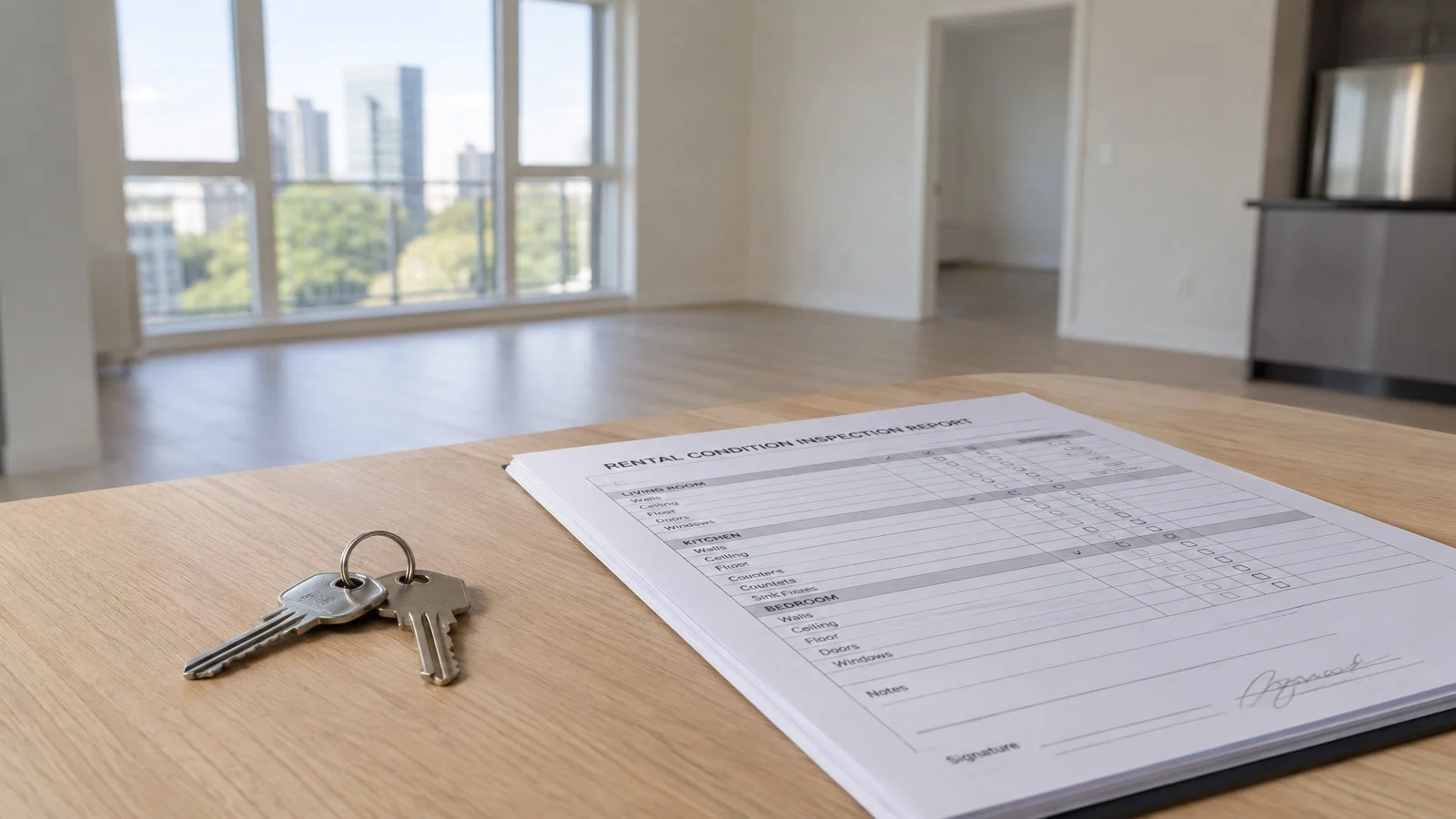
Alberta Security Deposit Rules: What Grande Prairie Landlords Can Legally Deduct
Key takeaways: Alberta caps a security deposit at one month's rent, pets included, and it must sit in an interest-bearing Alberta trust account within two banking days. Without properly completed move-in and move-out inspection reports you cannot keep any of it for damage, and the refund plus statement of account is due within 10 days of possession ending. The prescribed interest rate is 0% for 2026.
Most security deposit disputes in Alberta are not lost on the facts. They are lost on paperwork. A landlord can be completely right that a tenant wrecked the flooring and still hand back the full deposit, because a required inspection report was missing or a statement of account went out on day 14 instead of day 10.
Alberta security deposit rules sit in the Residential Tenancies Act (RTA) and its regulations, and they are unusually specific about timing and documentation. This is the practical version for owners renting out property in Grande Prairie and the surrounding Peace Country: what you can hold, where it has to sit, what you may deduct, and the deadlines that decide whether you keep a dollar of it.
How much you can collect, and what counts toward the cap
The maximum security deposit in Alberta is one month's rent. That is a hard ceiling, not a starting point, and there is no separate allowance stacked on top of it for pets, smoking, or "extra risk" tenants. A pet deposit lives inside the same one-month limit.
Two consequences owners routinely miss:
If a fixed-term lease simply continues as a periodic (month-to-month) tenancy under a clause in the agreement, it is the same tenancy, so the deposit cannot be topped up when rent rises.
If both parties sign a genuinely new fixed-term agreement, the rent and deposit can be renegotiated, still subject to the one-month cap.
Non-refundable fees are a separate matter and cannot be quietly renamed as deposit money. If a charge is refundable and held against the tenant's obligations, treat it as part of the security deposit and cap it accordingly.
The deposit is trust money, not working capital
Every security deposit collected in Alberta must go into an interest-bearing trust account at a bank, treasury branch, credit union, or trust corporation in Alberta, within two banking days of receiving it. Only security deposit money may sit in that account, and the landlord is the trustee of it on the tenant's behalf.
Interest is set annually by the province. The prescribed rate is 0% for January 1 to December 31, 2026, after 0.5% in 2025 and 1.6% in 2024 — the first years interest was actually payable since 2009. A zero rate does not remove the trust-account obligation, and it does not remove the interest paperwork if a tenancy spans years when the rate was above zero. Interest is payable to the tenant annually unless there is a written agreement that it will be paid at the end of the tenancy.
Self-managing owners who deposit rent and deposits into one chequing account are exposed here. The failure is invisible until a dispute, and then it is the first thing that surfaces.
No inspection reports, no damage deduction
This is the single most expensive rule for small landlords in Alberta.
You and the tenant must inspect the premises together within one week before or after the tenant takes possession, and again within one week before or after the tenant gives up possession. The landlord must complete a written report describing the condition each time, include the statements prescribed by regulation, have it signed, and give the tenant a copy immediately on completion. Keep it for at least three years.
If both the move-in and move-out reports are not properly completed, the landlord is not permitted to keep any of the deposit for damage beyond normal wear and tear. The claim does not shrink; it disappears.
A tenant who refuses to attend does not block you. You may complete the inspection without them if you proposed two inspection times on different days, neither a holiday, both between 8 a.m. and 8 p.m., and no adult tenant agreed to attend. Document the offers in writing — that record is the reason the unilateral inspection stands.
Photos and video are strong supporting evidence, but they are supporting evidence. They do not substitute for the signed report.
What you can deduct — and what you cannot
A security deposit can be applied to:
repairing or replacing physical damage to the premises;
cleaning required because of extraordinary or abnormal use;
arrears of rent;
other costs the tenant agreed to in the tenancy agreement, such as utilities or late fees, where those conditions were actually written into the agreement.
You cannot deduct for normal wear and tear, which the RTA defines as the deterioration that occurs over time with use even though the premises receive reasonable care and maintenance. Duration of tenancy matters: scuffs on walls and floors and nail holes from hanging pictures after a three-year tenancy are wear and tear, not damage. Alberta's dispute service will not entertain a claim for fixing wear and tear at all. If the line between the two is where your disputes keep landing, our breakdown of normal wear and tear versus tenant damage is worth reading alongside this article.
Two further traps. First, the deposit is not last month's rent — if a tenant skips the final month's rent, that is an arrears and eviction issue, and telling them to "use the deposit" invites a losing dispute. Second, in a joint tenancy the refund cheque must be made out to all tenants, not the one who asks first.
The 10-day and 30-day clock
Within 10 days after the tenant gives up possession, the landlord must deliver one of the following:
the full deposit; or
the balance plus a statement of account itemizing what was used, where deductions match conditions the tenant agreed to; or
where the correct amount genuinely cannot be determined yet, the balance the landlord does not intend to use plus an estimated statement of account — with the remaining balance and a final statement delivered within 30 days after possession ended.
Delivery means personal service, regular or registered mail, or another method agreed in writing; a mailed refund counts as delivered on the postmark date. Miss the deadline and the tenant can go to court or Alberta's Residential Tenancy Dispute Resolution Service (RTDRS) for the whole deposit, whether or not a statement was eventually sent.
Ten days is short. It is also the reason move-out repair quotes should be lined up before the tenant hands back keys, which is exactly what a disciplined turnover process delivers. Our Alberta landlord turnover checklist sequences the inspection, quotes, and cleaning so the statement of account can actually go out on time.
When a claim exceeds the deposit
If damage or arrears exceed one month's rent, the deposit is only partial recovery. The RTDRS handles claims up to $100,000 for former and current tenancies, and applications must be filed within two years of when the claim came to your attention. Filing fees are $75 for claims of $7,500 or less and $150 for larger claims, with hearings held by phone or video.
What decides those hearings is evidence: signed move-in and move-out reports, dated photos, invoices rather than estimates of your own labour, a ledger showing arrears, and proof of how documents were served. Owners who assemble that file during the tenancy win; owners who assemble it after the tenant is gone usually do not.
Why this matters more in the current Grande Prairie market
Grande Prairie's rental market has loosened. CMHC pegged the city's purpose-built vacancy rate at 2.3% in its most recent October survey, up from 2.1% a year earlier, while the average two-bedroom rent reached $1,445 in 2025. Rentals.ca and Urbanation put the average asking rent at $1,422 in August 2026, sixth-lowest among the 25 mid-sized markets they track.
Softer conditions change the deposit math in two ways. Higher rents over the past two years mean the one-month deposit you hold is worth more than it used to be, so more owners are tempted to lean on it. At the same time, longer vacancy periods mean a botched deduction costs twice: the refunded amount plus the days the unit sits empty while a dispute drags on. Rent-side decisions carry the same discipline — see our guide to Alberta rent increase rules for Grande Prairie owners.
A short compliance routine that prevents most disputes
Write the deposit amount into the tenancy agreement and never exceed one month's rent, pets included.
Move the deposit into a dedicated interest-bearing Alberta trust account within two banking days. If the unit is a condo, the corporation can also require a separate rental deposit from you; see condo rental rules in Alberta.
Complete, sign, and hand over the move-in report in the week around possession; store it for three years.
Spell out in the agreement any charges you may deduct, such as utilities or late fees.
Book the move-out inspection early, and paper the two offered times if the tenant will not attend.
Get repair and cleaning quotes before day 10 so the statement of account is itemized, not estimated.
Deliver the refund and statement inside 10 days, or send the estimated statement and close it out within 30.
None of this is complicated. It is simply unforgiving of gaps, which is why deposit money is where self-managing owners most often lose an argument they should have won.
Talk to a Grande Prairie property manager
Sutton Property Management handles deposits, trust accounting, inspection reports, and statements of account for owners across Grande Prairie and the Peace Country, so the deadlines are met without you tracking them. If you have a deposit question or a turnover coming up, get in touch with our team or review how our property management services work. Owners weighing self-management can also start with our owner FAQ.
Sources: Alberta Residential Tenancies Act ss. 19, 44–46 and the Residential Tenancies Ministerial Regulation; Security Deposit Interest Rate Regulation and Alberta.ca annual security deposit interest rate tables; Service Alberta RTA Handbook and RTDRS rules of practice; CMHC Rental Market Survey; Rentals.ca and Urbanation National Rent Report, August 2026. This article is general information, not legal advice.
How Much Can You Raise the Rent in Alberta? 2026 Rules for Grande Prairie Owners
Key takeaways: Alberta has no rent cap, but rent can only rise once every 365 days, never during a fixed term of a year or more, and a month-to-month increase needs three full tenancy months of signed written notice or the notice is void. With Grande Prairie vacancy at 2.3% and national asking rents down 4.8% year over year, the market — not the law — is what limits your number.
Almost every Grande Prairie owner we talk to in the fall asks a version of the same question: how much can I raise the rent, and when do I have to tell the tenant? Alberta's answer is unusual. There is no cap on the amount. What the province regulates is timing and paperwork — and those rules are strict enough that a sloppy notice can wipe out the increase entirely.
Here is what the current rules actually say, what the 2026 Grande Prairie market says about whether you should use them, and the calendar math that decides whether an increase makes you money or costs you a tenant.
There is no rent cap in Alberta — the limits are frequency, notice, and form
Alberta has no rent control and no annual guideline percentage. The province states plainly that there is no limit on the amount by which a landlord may raise the rent. If you see a page advertising an “Alberta rent increase guideline” for 2026, it is borrowing vocabulary from capped provinces like Ontario and B.C. Alberta publishes nothing of the kind.
What is regulated:
Once every 365 days. Rent cannot increase until at least 365 days have passed since the tenancy started or since the last increase, whichever is later. This comes from section 14(4) of the Residential Tenancies Act and section 3 of the Residential Tenancies Ministerial Regulation, and it applies “despite any agreement, declaration, waiver or statement to the contrary” — a lease clause promising more frequent increases is unenforceable.
No increase inside a fixed term of a year or more. If the 365th day lands mid-term, the increase waits until the term ends.
Consecutive short fixed terms do not reset the clock. Where a tenant occupies the same premises under back-to-back fixed terms of less than one year, the 365 days are measured from the start of the first agreement in the chain. Re-signing paperwork resets nothing; only time does.
Written notice, on a periodic tenancy. For month-to-month tenancies you must serve at least three full tenancy months of written notice. It is 12 full tenancy weeks for week-to-week, and 90 days for any other periodic tenancy. Longer notice in your lease wins over the statutory floor.
The notice must contain all required elements: the effective date of the increase, the landlord's signature, and the date the landlord signed. A notice missing any of those is void, and rent cannot be increased until a compliant notice is served and the full notice period runs again. Notices must go to each tenant individually — posting one in a common area does not increase anyone's rent.
Two more points owners routinely get wrong. First, a periodic tenant who receives a proper notice and does not give notice to terminate is deemed to have accepted the increase — there is no negotiation requirement and no approval step. Second, notice of a rent change is not legally required when a fixed-term tenancy ends and you offer a new agreement at a new rent, because the old tenancy simply expires. That is a legal shortcut, not a business one: a tenant handed a surprise number at renewal is a tenant shopping for somewhere else.
Alberta tribunals expect a real reason, applied evenly
“No cap” is not the same as “anything goes.” Reviewing the case law in May 2026, the Alberta Law Reform Institute and commentators at ABlawg noted two consistent principles from Residential Tenancy Dispute Resolution Service and court decisions: an increase must have a bona fide economic rationale, and it cannot be applied selectively — for example, singling out the one tenant who complains about repairs. An increase you can tie to documented operating costs, insurance, property taxes, or verified market rents is defensible. One you cannot explain is an invitation to a dispute you did not need.
What the 2026 Grande Prairie market says about using that freedom
The legal ceiling is irrelevant if the market will not pay it. Current local evidence:
CMHC's October 2025 survey put the Grande Prairie vacancy rate at 2.3%, up from 2.1% a year earlier, with average rent at $1,392 — a 5.8% increase, roughly half the 10.0% jump recorded the year before.
The Rentals.ca and Urbanation National Rent Report for August 2026 put Grande Prairie's average asking rent at $1,422, the sixth-lowest among the 25 mid-sized markets it tracks. Six of the eight cheapest markets in that ranking are in Alberta.
Nationally, average asking rent fell 4.8% year over year in August 2026 — the twenty-third consecutive month of decline.
Read together: rent growth in Grande Prairie is still positive but decelerating, vacancy is loosening, and the wider market is discounting. That is a market where an aggressive in-place increase is more likely to trigger a move-out than to lift annual income. We covered the same shift in more detail in our look at what rising vacancies mean for Grande Prairie property owners.
The math that actually decides it
Take a unit renting at $1,400 a month. A 5% increase adds $70 a month, or $840 over a year. Now price the downside: one vacant month is $1,400 gone, plus cleaning, paint touch-ups, advertising and your own time between tenants. A single month of vacancy erases roughly twenty months of that increase, and that is before turnover costs.
The practical thresholds we work with:
In-place tenant paying near market, low risk of leaving: a modest increase that keeps the unit slightly under asking rents usually beats chasing the top of the market.
Rent well below market after several flat years: stage the correction over two annual cycles rather than one large jump, and support it with maintenance the tenant can see.
Chronic problems — late payment, damage, complaints: a rent increase is not a discipline tool. Handle the tenancy issue on its own terms.
If you do end up in a turnover, speed is what protects the year. Our 10-day turnover checklist for Alberta landlords lays out the sequence that keeps a unit off the market for days rather than weeks.
Worked example: a month-to-month notice calendar
Say you want a new rent effective January 1 on a month-to-month tenancy that runs on calendar months, with the last increase effective more than a year earlier. Three full tenancy months of notice means October, November and December must each be complete months after service — so the signed notice must be served on or before September 30. Serve it on October 2 and the earliest lawful effective date moves to February 1. Miss a required element on the form and the clock restarts from the day you serve a compliant one.
Build the paper trail: keep a dated copy of the signed notice, record how and when it was served on each tenant, and note the market evidence behind the number. If the increase is ever questioned, that file is your case.
A five-point check before you send anything
Have 365 days passed since the tenancy began or the last increase took effect?
Is the tenancy periodic, or inside a fixed term where no increase is allowed yet?
Does the written notice show the effective date, your signature, and the date you signed?
Does the effective date leave the full statutory notice period — three full tenancy months on month-to-month?
Can you defend the number with real costs or comparable rents, applied to every comparable unit you own?
Talk it through before you commit
Rent setting in a softening market is a judgment call, and the wrong call costs a full month of income rather than a few dollars. We track what units in Grande Prairie are actually leasing for, not just what they are listed at, and we serve increase notices that stand up. If you want a second opinion on a renewal or a rent review across a portfolio, see how our Grande Prairie property management services work, or read the owner FAQ for how we handle renewals and rent reviews. Reach out through our contact page and we will give you a straight answer on the number.
Sources
Government of Alberta, During a tenancy (rent increase rules and notice periods); Residential Tenancies Act, SA 2004, c R-17.1, s. 14; Residential Tenancies Ministerial Regulation, AR 211/2004, s. 3 (consolidated to AR 162/2026, current as of June 29, 2026); Service Alberta RTA Handbook, Rent increases; ABlawg, “Can a Landlord Double Your Rent?” (May 25, 2026); CMHC Rental Market Survey, Grande Prairie historical summary (October 2025); Rentals.ca and Urbanation National Rent Report as reported by EverythingGP (September 10, 2026).